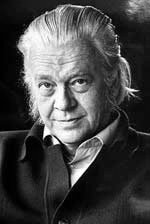
Schumacher opens
Small is Beautiful (1973) with a chapter on "the problem of production." As he sees it, "[o]ne of the most fateful errors of our age is the belief that 'the problem of production' has been solved" (3*). Such a fictitious belief sees the "rich countries" as essentially industrialized and able to produce goods and services in mass quantities (presumably available to all), with all that remains being a need to focus on "education for leisure" and the "transfer of technology" to the "poor countries" (3). Opposing this attitude, Schumacher's goal in the first chapter is to show that problems do indeed still exist.
MODERN MAN'S ATTITUDE TOWARD NATURE
(OR HUMANITY'S FORGETFULNESS OF IT'S OWN ROOTS)For Schumacher, "The arising of this error, so egregious and so firmly rooted, is closely connected with the philosophical, not to say religious, changes during the last three or four centuries in [Western] man's attitude to nature" (4). What exactly is this new attitude? The following text is worth quoting in its entirety:
Modern man does not experience himself as a part of nature but as an outside force destined to dominate and conquer it. He even talks of a battle with nature, forgetting that, if he won the battle, he would find himself on the losing side. Until quite recently, the battle seemed to go well enough to give him the illusion of unlimited powers, but not so well as to bring the possibility of total victory into view. This has now come into view, and many people, albeit only a minority, are beginning to realize what this means for the continued existence of humanity. (4)
This perspective is quite fascinating and worth discussing. Schumacher's assessment rings even truer today in my opinion, as we grow increasingly dependent upon the digital world of computers and the web. Truly, where is the sense of vitality and connection to life in our modern mechanized milieu?
Despite Schumacher's valuable insights here, though, I also think more could have been said to make his case even stronger. He could have easily given historical examples of the frequency of imperialistic attitudes in both modern science and economics. For instance, consider even the earliest modern philosopher-scientists, Francis Bacon and Rene Descartes, with their talk of dominating and lording over nature.
Also, if time allows it, perhaps we can ask ourselves here another equally important unaddressed question: why exactly have we moved in this direction? Is it simply our increased technological ability to control nature that tempts us down this road, or are there additional factors? Are there religious or philosophical influences? Are evolutionary forces at play, and are they stronger in males than females, as many feminists have argued?
I don't have any sort of final answer, but I think these kinds of questions would be worth considering here, in addition to the diagnosis Schumacher has given.
NATURAL CAPITALAnother one of Schumacher's central points is the notion that we have failed to see just how dependent we really are upon nature. Previous economic theorists tended to see capital only as that which is produced by humans, while the land and its resources were understood merely as income. Schumacher wants to completely reorientate this vision:
Far larger is the capital provided by nature and not by man--and we do not even recognise it as such. This larger part is now being used up at an alarming rate, and that is why it is an absurd and suicidal error to believe, and act on the belief, that the problem of production has been solved. (5)
In other words, we have failed "to recognize that that the modern industrial system, with all its intellectual sophistication, consumes the very basis on which it has been erected. To use the language of the economist, it lives on irreplaceable capital which it cheerfully treats as income" (9). As far as I can tell, Schumacher was one of the first to speak of "
natural capital," an idea that has become increasingly influential since the 1990s, with growing interest in another concept--
sustainability--and numerous ecologists and economists in recent years giving estimates of the annual economic value of nature ($2.9 trillion U.S. dollars, according to
one calculation).
Still, I wonder how far we can go with this method. Yes, it may be helpful in getting profit driven businesses and corporations (and even governments) to see the $ value of nature, but we still seem to primarily be looking at nature from the perspective of the market. Are there higher values than the almighty dollar (or pound or whatever else) that ought to be influencing our attitude toward nature and humanity?
Schumacher himself suggests higher values, but with little development. For example, after looking at our limited sources of fossil fuels, he makes the following poignant remark: "If we squander our fossil fuels, we threaten civilisation; but if we squander the capital represented by living nature around us, we threaten life itself" (6). Life itself then, seems to be a higher value. Are there others though, such as cultural values for example, that a mere market perspective seems to show little or no concern about (aside from whether they might bring in profit)?
A CLARION CALLSchumacher closes the opening chapter then with a urgent call for us to change paths from our present "collision" course. He admits that humans "have indeed been living on the capital of living nature for some time, but at a fairly modest rate." "[T]he changes of the last twenty-five years, both in the quantity and in the quality of man's industrial processes," however, "have produced an entirely new situation"--"our present crisis" (7-8). As he sees it, we are now in the process of destroying the very foundations upon which we exist, yet many of us still don't even realize it.
Schumacher believes everyone needs to get involved in order to tackle these problems, for "[to talk about the future is useful only if it leads to action now" (9-10). What follows are a number of prescriptions which will presumably be elaborated upon throughout the book:
We must thoroughly understand the problem and begin to see the possibility of evolving a new life-style, with new methods of production and patterns of consumption: a life-style designed for permanence [much akin to the "sustainability" idea mentioned earlier]...
In industry, we can interest ourselves in the evolution of small-scale technology, relatively nonviolent technology, "technology with a human face," so that people have a chance to enjoy themselves while they are working, instead of working solely for their pay packet and hoping, usually forlornly, for enjoyment solely during their leisure time...
We can interest ourselves in new forms of partnership between management and men, even forms of common ownership. (10)
All of these potential remedies are worth exploring in greater detail, but I'm not sure we should do this now since they look to (hopefully!) be further developed in later chapters.
Lastly, Schumacher closes with the following remark--"we still have to learn how to live peacefully, not only with our fellow men but also with nature and, above all, with those Higher Powers which have made nature and have made us" (10). Again, I'm not entirely sure what he means here, but since it looks like he'll be dealing specifically with this in the next chapter, perhaps discussion of this too can wait until then.
_________
* Excerpts cited here come from the 25th anniversary edition: E. F. Schumacher, Small is Beautiful: Economics As If People Mattered, 25 years later . . . with commentaries (Point Roberts, WA: Hartley & Marks, 1999).